
What makes Saturn different?
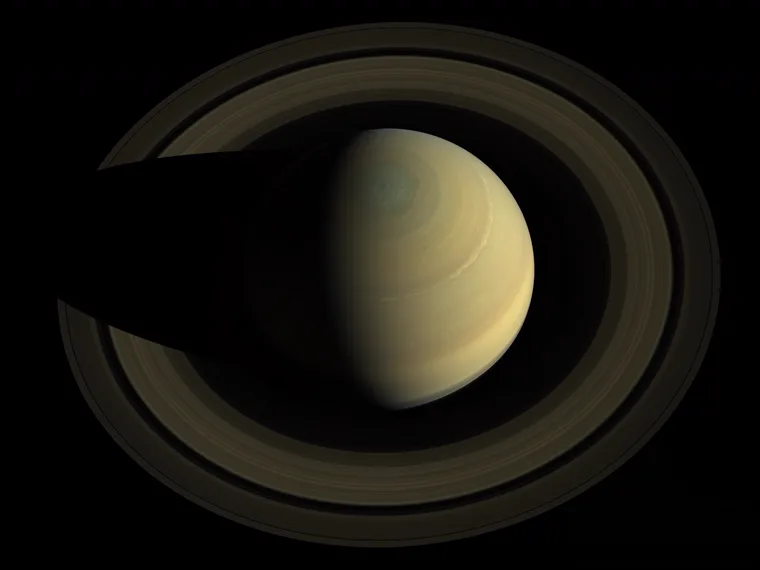
Saturn is a gas giant surrounded by a ring system made of countless particles, largely water ice with other material. It has no solid surface like Mars. The rings are broad but very thin compared with their width, making the viewing angle especially important.
Try this in Argus
Orbit Saturn and compare a broad view of the rings with an edge-on view. Look for the main divisions, then inspect Titan and Enceladus through the moons selector. Compare what is visible at the surface with the evidence used to infer hidden environments below it.
Read the mapping before the scenery
Hubble OPAL Cycle 32 composite, 29 August 2025, 1800 × 900 (5 pixels/degree). Usable coverage is conservatively limited to 78° S–78° N. Missing pixels, polar limbs and the ring-occulted equatorial strip use featureless zonal interpolation. The rings use a Cassini PIA11142 natural-colour radial scan (26 November 2008), approximately registered to the C/B/A boundaries, Cassini Division and narrow F ring. Repeating that radial colour scan around the planet, opacity, spherical shadow approximation and inspection lighting are illustrative. This dated map is not current weather. Atmospheric study adds simulated differential cloud motion and limb haze, with approximate ring shadows on the body. Observed Hubble map and the coverage overlay preserve the unwarped source.
Saturn at a glance
Measurements are reference values. Giant planets have no solid surface; atmospheric reference levels are used for quantities such as gravity.
- Atmospheric temperature at 1 bar
- About −139°C (134 K)A reference level near Earth’s sea-level pressure. Temperature varies with altitude and weather.Source ↗
- Mean radius
- 58,232 kmSource ↗
- Mass
- 568.317 × 10²⁴ kgSource ↗
- Bulk density
- 0.6871 g/cm³Source ↗
- Sidereal rotation
- 10.66 hoursRotation relative to distant stars; this differs from sunrise-to-sunrise day length.Source ↗
- Orbit around the Sun
- 10,755.7 Earth daysConverted from JPL Julian years of 365.25 days.Source ↗
- Moons in Argus catalog
- 293 · 2026-10-31Source ↗
Before you begin
Are the ring particles individually simulated?
No. Argus uses observed colour information and a modeled ring presentation. Ring lighting, opacity and inspection effects help make the structure readable; they are not a particle-by-particle measurement.
Read the sources
Scientific sources provide context. Argus is an independent project; a source link does not imply endorsement.