
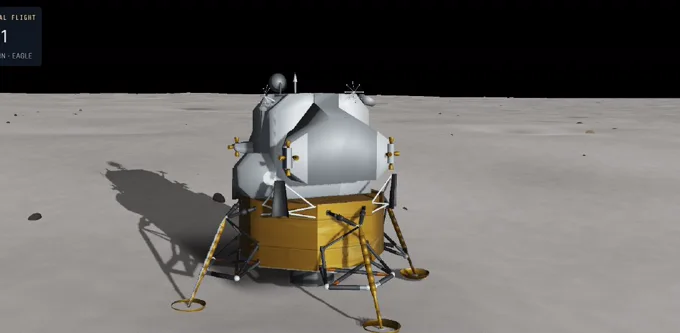
A journey with different jobs
The mission begins after Saturn V has reached orbit. You work through spacecraft alignment and docking, the journey to the Moon, lunar approach, landing, surface objectives and the return to Earth. The challenge changes as the spacecraft and environment change.
Read the current objective before applying thrust. During alignment, small corrections are easier to judge than long inputs. Near a target, reduce relative motion before trying to close the final distance. The mission’s help explains the controls for the current phase.
History behind the game
Apollo 11 landed Neil Armstrong and Buzz Aldrin on the Moon in July 1969 while Michael Collins remained in lunar orbit. Argus uses that historical journey as the basis for an interactive mission, including original NASA radio calls at selected events.
The game compresses time and simplifies systems so the journey is playable in a browser. Its spacecraft handling, objectives and visual reconstruction are not astronaut training software or an exact engineering model. Read the historical context separately from the game’s convenience controls.
Turn the flight into an investigation
- Before launch, identify which spacecraft must dock and why.
- During descent, notice the relationship between sideways motion, altitude and the landing target.
- After returning, explain why the lunar module did not fly all the way back to Earth.
- Visit the Apollo 11 landing region in the Moon explorer and compare the mapped view with the mission scene.
Read the sources
Scientific sources provide context. Argus is an independent project; a source link does not imply endorsement.