What makes Earth different?
Earth has liquid water at its surface and an atmosphere that supports life as we know it. Rotation gives us the day-night cycle. Its tilted axis changes the distribution of sunlight through the year; seasons are not simply a result of being closer to the Sun.
Try this in Argus
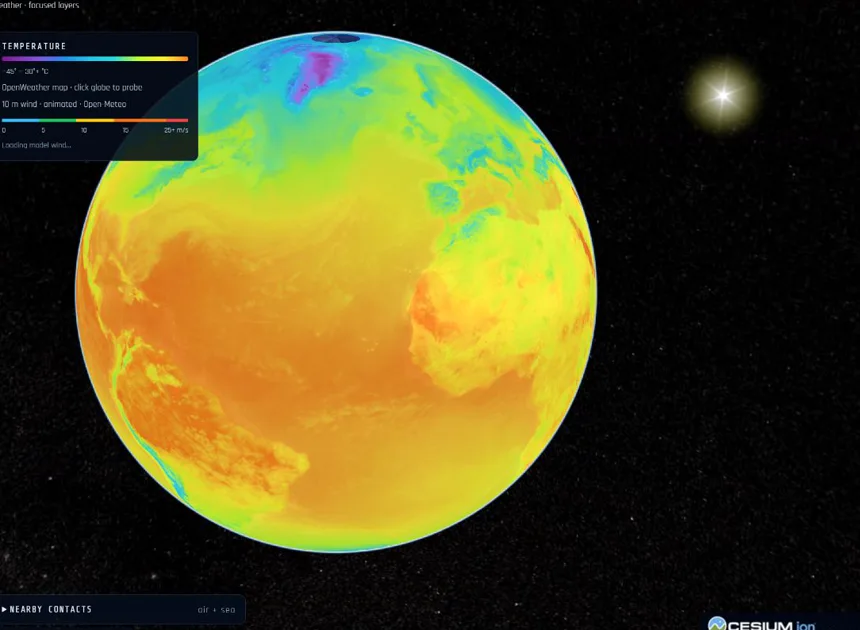
Begin with the globe, then open the weather preset. Compare a coastal region with an inland region at a similar latitude. Look at the layer legend and observation time before drawing a conclusion. Use the orbit science lab to connect the view of Earth with how spacecraft remain in free fall around it.
Read the mapping before the scenery
Your Earth camera, layer choices and display settings are preserved while exploring.
Earth at a glance
Measurements are reference values. Giant planets have no solid surface; atmospheric reference levels are used for quantities such as gravity.
- Mean surface temperature
- About 15°C (288 K)A rounded global reference. Local conditions vary with weather, elevation, and season.Source ↗
- Mean radius
- 6,371.01 kmSource ↗
- Mass
- 5.97217 × 10²⁴ kgSource ↗
- Bulk density
- 5.5134 g/cm³Source ↗
- Sidereal rotation
- 23.93 hoursRotation relative to distant stars; this differs from sunrise-to-sunrise day length.Source ↗
- Orbit around the Sun
- 365.256 Earth daysConverted from JPL Julian years of 365.25 days.Source ↗
- Moons in Argus catalog
- 1 · 2026-10-31Source ↗
Before you begin
Are all Earth layers updated at the same time?
No. Imagery, weather products, aircraft reports and calculated satellite positions have different sources and update schedules. Inspect source and freshness information for the layer you are using.
Read the sources
Scientific sources provide context. Argus is an independent project; a source link does not imply endorsement.